
As Editor-in-Chief of Equilife World Magazine, I am drawn to places where horses exist within a wider creative landscape — where sport, art, design, atmosphere, and equestrian heritage come together, preserving the traditions and craftsmanship that have shaped the horse world for generations. Saut Hermès is one of the few events where these worlds converge so seamlessly.
By Therese S. Alhaug /Ph. Therese S. A. / Morgan Froment
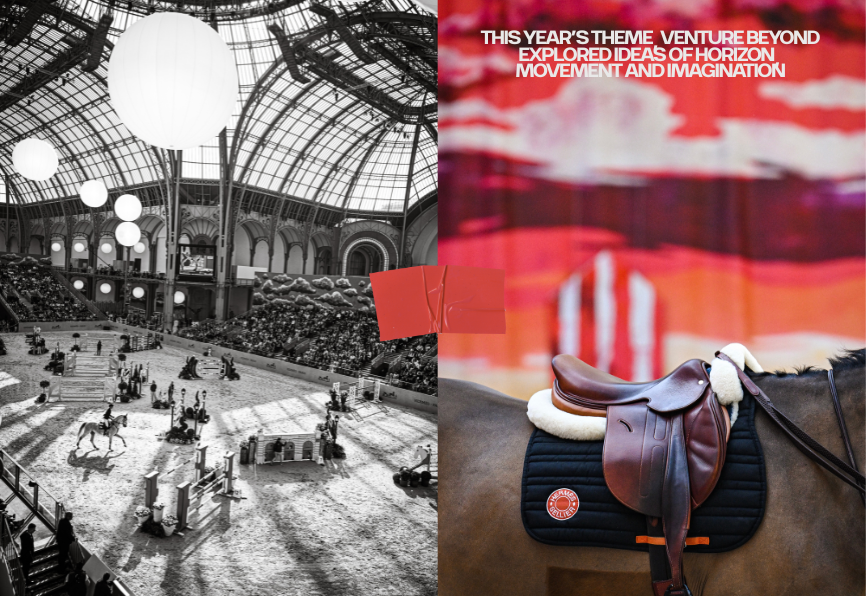
Held each March beneath the glass roof of the Grand Palais in Paris, the Saut Hermès brings together CSI 5* show jumping at the highest international level and an annual creative framework developed by Hermès. The result is not just a competition, but an ever-changing experience built around horses, riders and a constantly evolving visual landscape.

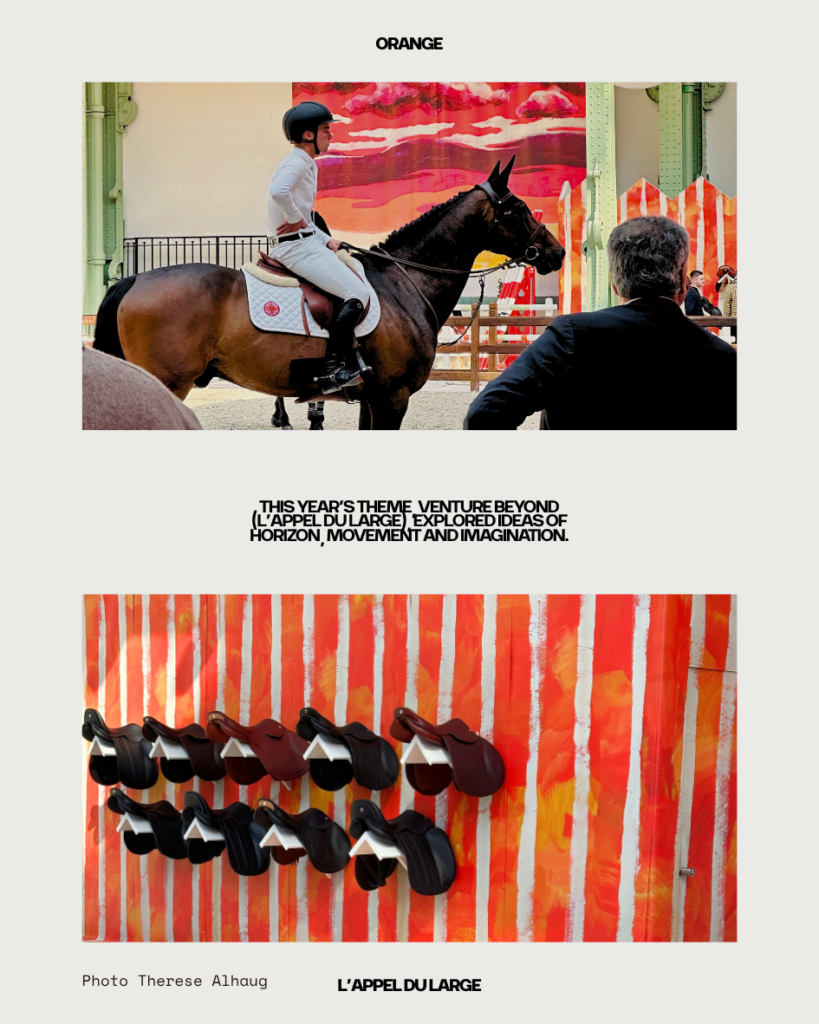
This year’s theme, Venture Beyond (L’appel du large), explored ideas of horizon, movement and imagination. Inside the Grand Palais, the concept was not simply illustrated — it was made physical. The arena floor was covered in sand, softening the monumentality of the architecture and transforming the way the space was experienced. What is usually perceived as a vast, sculptural space instead took on the feeling of an open landscape, where light, perspective and movement were constantly shifting.
The scenography moved toward suggestion rather than statement. Straw parasols, sculptural seahorse forms, and a palette drawn from tropical and marine references created a quiet shift in perception. There was a sense of shoreline rather than stage, of tide and air rather than enclosure.


At moments, the atmosphere slipped into an underwater dreamscape, something almost narrative and imagined rather than literal. I had a sense of being submerged in a fairytale logic, reminiscent of Alice in Wonderland, but beneath the surface. Surrounded by coral-toned light, sea sand underfoot, and towering seahorse sculptures, the space dissolved into something fluid and immersive. Less representation, more resonance, where land and sea, reality and imagination gently blurred.
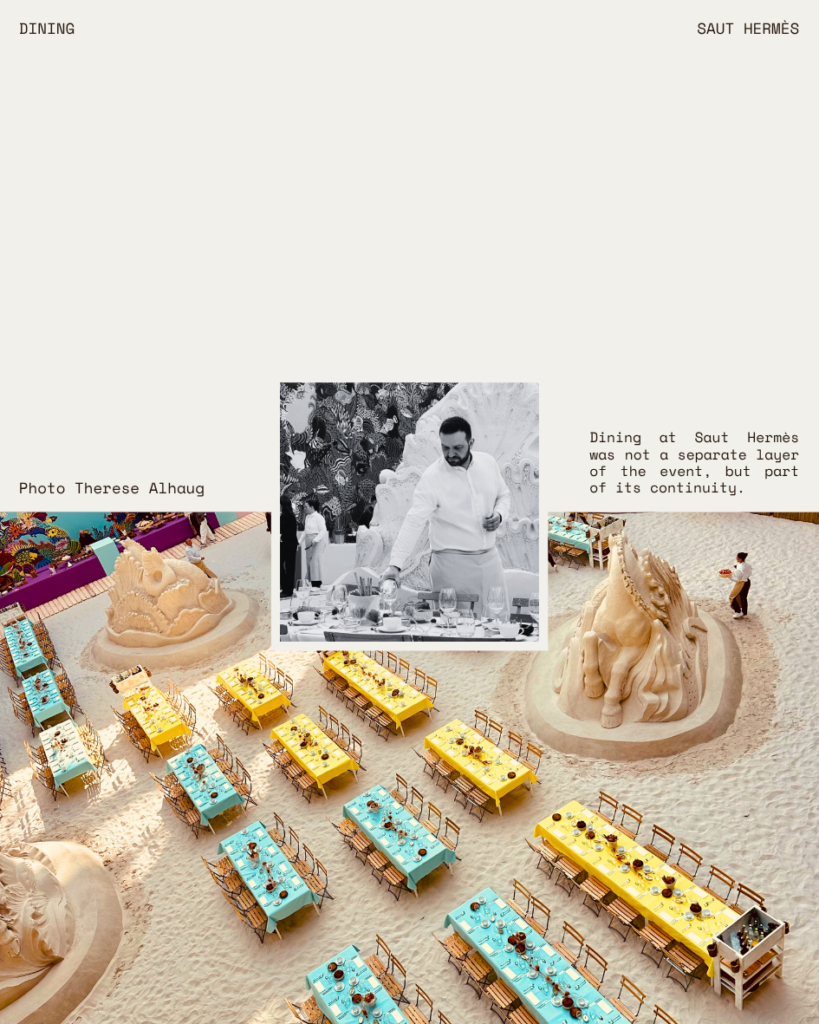
The same language extended into the hospitality spaces, where dining at Saut Hermès was not a separate layer of the event, but part of its continuity. Food became an experience in itself — beautifully presented in small French portions, allowing the palate to move through a journey of refined flavours from land and sea.
Seated in the sand with exquisite dishes and fine wine, the setting felt almost theatrical, held within an atmosphere of quiet wonder. A large installation evoking an underwater landscape of fish, coral formations and shifting turquoise tones carried the dining space into the same narrative world, every detail woven into a single, continuous experience. Yet just beyond the wall, the sound of galloping horses reminded you of the reality behind the scene.
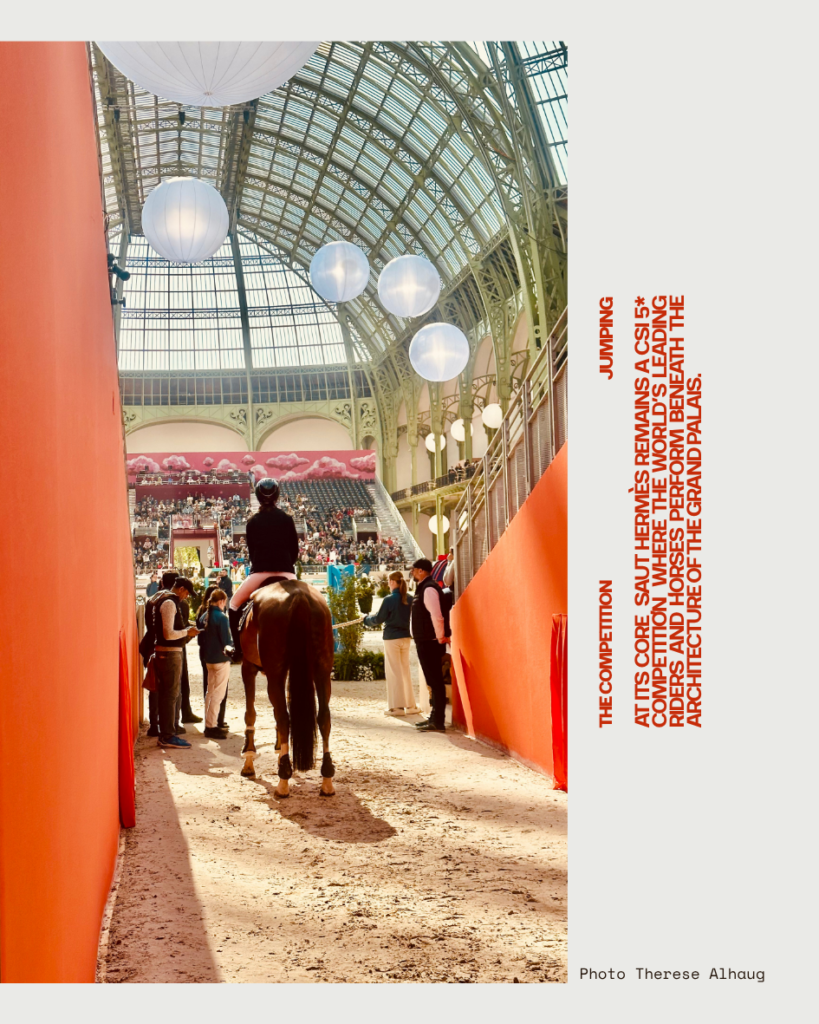
At its core, Saut Hermès remains a CSI 5* competition, where the world’s leading riders and horses perform beneath the architecture of the Grand Palais. The sport is exacting and highly technical, yet the environment subtly reshapes its perception. There is a clarity to the riding, softened by the space itself — light filtering through glass, sand absorbing sound, architecture framing movement.
This year’s programme included Percussive Harmonies, a live performance in which horses, riders and musicians shared a structured rhythm of sound and movement. It extended the idea of the arena as a space of overlap — where disciplines meet without needing to merge.


At moments, the atmosphere slipped into an underwater dreamscape, something almost narrative and imagined rather than literal. I had a sense of being submerged in a fairytale logic, reminiscent of Alice in Wonderland, but beneath the surface.
For Equilife World Magazine, this is where the event becomes particularly interesting. The horse is not positioned as spectacle, but as part of a broader cultural vocabulary — one that moves between craft, performance, design and lived experience. That sense of depth carried beyond the arena itself, into quieter corners of the Grand Palais.
I found myself wandering through a bookstore filled entirely with horse-related titles — from historical and cultural works to fiction, sport and children’s books. Around it, Hermès’ equestrian universe unfolded through displays showing the craftsmanship behind its saddles and riding equipment, offering a closer look at the making, tradition and materiality behind the sport.
It was striking to see how naturally these spaces invited pause and attention. In a time often defined by speed and distraction, the atmosphere carried a quieter rhythm — one of focus, detail and sustained curiosity.

The experience of Saut Hermès is also inseparable from the city itself. This year, I stayed in a small boutique hotel within walking distance of both the Champs-Élysées and the Grand Palais. The setting becomes part of the rhythm of the days — moving between the quiet of the hotel, the intensity of the arena, and the softness of Paris in early spring.
Outside, the city is in transition. Trees begin to open again, light changes across the façades, and terraces slowly reappear. Saut Hermès sits naturally within this moment — not as an isolated event, but as something that responds to its surroundings.
What remains with me is not a single impression, but the way everything connects: sport, material, space, and season. Saut Hermès works best when experienced as a whole — not as performance or installation, but as a temporary world shaped by all of it at once.


