
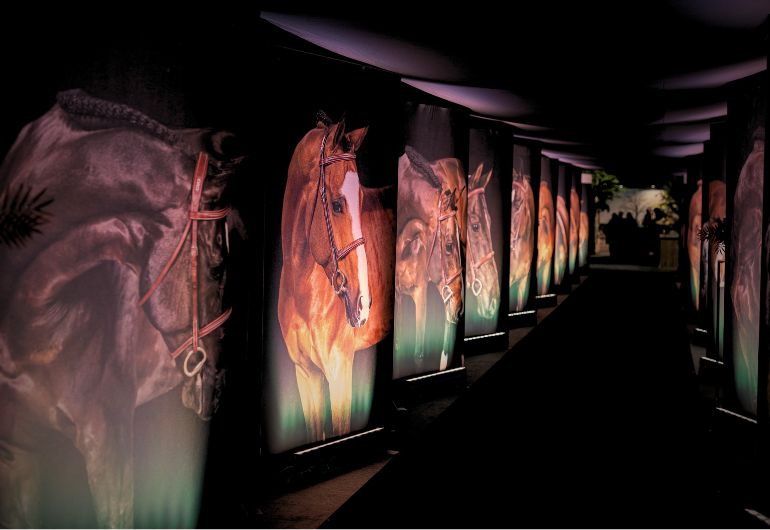
Once primarily a marketplace for buying and selling horses, the modern equestrian auction is evolving into something considerably bigger. Fine dining, entertainment, international networking and digital reach are turning the auction floor into a global marketplace — and a business in its own right.
Text: Therese Alhaug. Photo: Aloga Auction.
The transformation accelerated during the pandemic. With travel restricted and traditional horse trading disrupted, the equestrian industry was forced to rethink how horses could be presented, marketed and sold to an international clientele.
In 2021, brothers Bertram and Harry Allen, together with their friend and fellow showjumper Maxi Lill, were among those quick to recognise the opportunity. They launched Aloga Auction with a focus on carefully selected, top-quality showjumpers, combining their sporting expertise and international network with a new approach to how horses could be presented and sold.
A year later, Laurens Meynaerts of Sentower Park joined the team. His extensive experience in staging international equestrian events brought another dimension to the concept, while Sentower Park in Belgium provided a setting in which the auction could develop into something considerably bigger than a traditional sales night.
What began as an innovative way of bringing horses and buyers together has since developed into an international event where sport, business, hospitality and entertainment meet.
From sales ring to international marketplace
The numbers illustrate the scale of that development.
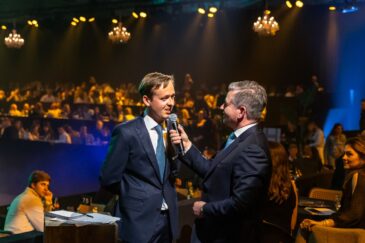
By 2026, Aloga had sold 99 horses for a combined €30.82 million, while welcoming 4,826 attendees to its events. Its international reach extends considerably further through online bidding, livestreaming and social media.
The sixth edition, held at Sentower Park in May 2026, provided perhaps the clearest indication yet of the commercial scale the concept has achieved. The evening generated €9.633 million in sales, with the average price of the showjumping horses reaching €476,579.
These are figures that illustrate a fundamental change in the horse market: the audience is no longer limited by the number of chairs around an auction ring.
Digital bidding allows a potential buyer sitting ringside in Belgium to compete for the same horse as someone bidding from the United States, Scandinavia, the Middle East or Asia. The physical auction has become the centre of an event, while the actual marketplace stretches far beyond it.
Performance meets prestige
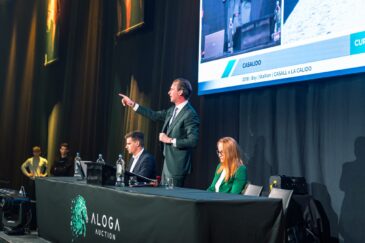
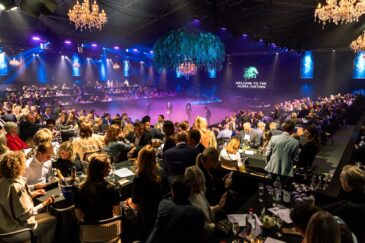
At Sentower Park, the auction itself sits within a carefully staged evening. High-quality horses remain the central product, but hospitality, food, entertainment and an international guest list have become an important part of the experience.
And the prices can be substantial.
Aloga’s record remains Dark Chocolate, sold for €2.3 million in 2024.
In 2026, another seven-figure sale demonstrated continued demand at the top of the market. Seven-year-old stallion Orpheus (Jappeloup x Chaman) topped the sixth edition at €2.1 million, selling to a Swedish buyer. Before entering the auction, Orpheus had already recorded an 89 per cent clear-round rate internationally.
Buyers in the 2026 edition came from markets including Norway, Sweden, Austria, the United States, Poland, Ireland and Germany, with bidding taking place both online and in the room.
The figures also reveal the depth of the market. Of the 23 horses offered in 2026, 21 reportedly sold for more than €100,000, six reached at least €500,000, and one crossed the €2 million mark.
For an auction house, however, sporting results after the sale may ultimately be as important as spectacular prices on the night. A headline figure attracts attention; horses that subsequently perform at international level build credibility for future collections.
That creates a commercial cycle of its own: successful horses strengthen the auction’s reputation, reputation attracts better horses and buyers, and better horses and buyers strengthen the brand.
Expanding the market
The concept has also moved beyond its original showjumping base.
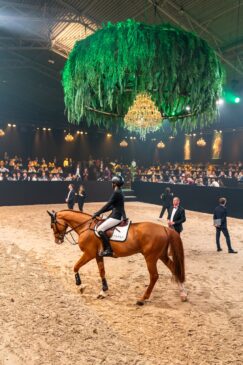
In 2024, both dressage and hunter horses were introduced to the Aloga collections. Among the buyers was Danish Olympic dressage rider Cathrine Laudrup-Dufour, who purchased the promising young horse Fuego.
The auction has since developed into a multi-discipline platform, presenting dressage horses, showjumpers and American hunters to an increasingly international customer base.
Aloga has taken that reach beyond Europe as well, becoming the first to stage a live horse auction in China.
For sellers, international exposure provides access to a much larger pool of potential customers. For buyers, part of the attraction lies in the curation: the expectation that the horses offered have already passed through a selective sporting and commercial filter.
For the auction house, meanwhile, the most valuable asset may ultimately be its reputation — and the number of returning customers provides one measure of that trust.
The auction becomes an event
Aloga is part of a wider development across the international horse market.
Leading auctions are increasingly competing not only for the best horses, but also for the right buyers — and for their time and attention.
That has changed the setting.
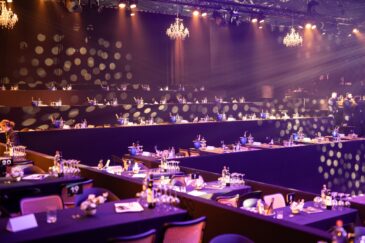
Dinner, cocktails, entertainment, VIP tables and after-parties have become part of the programme at several high-profile European auctions. The sale remains the centrepiece, but it is increasingly wrapped inside a complete evening designed to attract owners, investors, riders, breeders, trainers and dealers.
The concept has parallels with other luxury markets, where the experience surrounding a product becomes an important part of its positioning. Exclusivity creates interest, hospitality encourages guests to stay, while the social setting brings buyers, sellers and decision-makers into the same room.
For the equestrian industry, where relationships, reputation and personal networks have always played a significant role in high-value transactions, the combination is particularly powerful.
A potential horse purchase may be the reason for attending. The contacts made over dinner may prove equally valuable.
A new hybrid model
The pandemic did not create the international horse trade, nor did it invent online auctions. But it accelerated a change in behaviour. Digitalisation provides international reach. The live event provides exclusivity, hospitality, networking and the emotional element that has always been important when buying exceptional horses.
The result is a new hybrid model: part auction house, part sporting showcase, part networking arena and part luxury experience.
The hammer still matters. But today, the business begins long before it falls.
