
Some have described it as an Irish Colosseum. The gate closes and the athlete is met with rapturous applause. Instead of a gladiator, it is a horse mounted by one of the world’s top showjumping riders. Instead of lions, there is a course of the most challenging fences on the equestrian circuit.
By Frank Mulvihill. Photo Therese Alhaug
The noise resounds around the enclosed arena as the athletes prepare to do battle. Egyptian rider and Puissance winner Sameh El Dahan on his first visit describes it well: “Once the gate closed I felt like I could walk on water”. Riding an Irish-bred horse that he sat on for the first time just a few days before, the debutant jumped 2.20m over the bright red wall fence to pocket over €10,000 for his evening’s work. His mount, Seapatrick Cruise Cavalier is a 13-year-old gelding bred for eventing. He competed in Dublin as a 4 and 5-year-old in the Future Event Horse competitions and was loaned to Sameh to take his chance in the Puissance class. On this occasion, two riders jumped clear in the fifth and final round but a hesitation on the approach saw Venezuelan rider Andres Rodriguez given four faults and second place. The atmosphere of fun and enjoyment was epitomised by both of these riders who encouraged the spectators through the five-round competition. In a special moment after jumping clear in the fourth round, the Venezuelan took off his show jacket to reveal a Green Irish rugby jersey and the crowd were euphoric. That is Dublin Horse Show. It has that special ingredient that appeals to the spectator. It has fun and entertainment at its core, something that is sadly lacking at many of the so-called ‘top’ shows in the world.

High Expectations
This year’s show was a special one for many reasons. In particular, Team Ireland Equestrian’s showjumping team were fighting to retain their Division 1 league status at this final leg of the Furusiyya FEI Nations Cup jumping league. Secondly, the Irish have high expectations when it comes to the Nations Cup in Dublin. Most citizens have watched the teams do battle for the coveted Aga Khan trophy on television since they were young children. It is part of their heritage, horsey people and non-horsey people alike. So, one can appreciate the pressure that comes with participating on the team and with being the team manager.
“That is Dublin Horse Show. It has that special ingredient that appeals to the spectator. “
Robert Splaine is Team Ireland Equestrian’s showjumping manager and chef d’equipe. He holds all the credentials for the position having jumped and won on many teams himself. He will admit that the current position he holds is every bit as difficult as riding the courses. If riders or horses perform badly he will be blamed by some for making the wrong selection. That comes with the territory. However, Splaine has shown over the years that he carries out his role with professionalism and has high standards. On this occasion in Dublin, he has decided to pick former Olympic Bronze medallist Cian O’ Connor on a new nine-year-old horse Good Luck, USA based Darragh Kenny on Sans Soucis Z, first timer Greg Broderick on MHS Going Global and 19-year-old rising star Bertram Allen on the 17-year-old stallion Romanov. Allen’s first choice mount Molly Malone was being rested having won the Grand Prix in Dinard, France, just a few days earlier. She is needed for the European Championships in ten days time where Ireland need to perform well to qualify for the Olympic Games in Rio 2016. So many unknowns, inexperienced horses, inexperienced riders and the expectation of a home win by a knowledgeable Irish crowd. No pressure!

The teams are traditionally paraded before the Nations Cup in Dublin. Lead by the Irish defence forces band, the sound of bagpipes played havoc with many of the visiting horses while those of Team Ireland seemed oblivious to it. Bagpipes were once used in battle to frighten the horses of opposing armies. Could this be part of the plan to test the opposition?

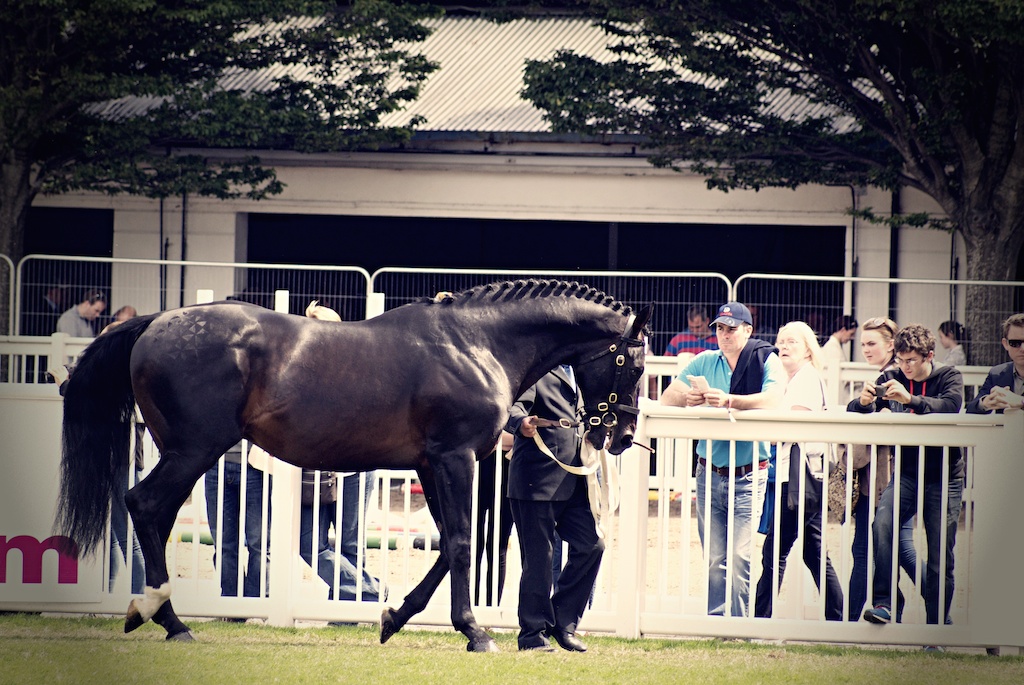
Drawn first wasn’t what Splaine would have liked for his 19-year-old pathfinder Bertram Allen and his horse, just two years younger, but he has confidence in the pair. A single error in what was otherwise an impeccable round of jumping got the team off to a four-fault start. This was followed by three clear rounds from Allen’s teammates to put the Irish in the lead at the half way mark. The crowd oozed an air of anticipation. Could the riders in green repeat their success of 2012? The answer was soon evident. Another clear round by debutant Greg Broderick and MHS Going Global followed by four faults from Cian O’ Connor on his promising new horse Good Luck meant the Irish could not be beaten, and the anchor rider Darragh Kenny and his horse Sans Soucis Z did not have to jump a second round. Impressive. At the post-competition press conference, Kenny admitted he would like to have jumped again just to hear the roar of the crowd. The 20,000 spectators were elated and the victory set the tone for the remainder of the weekend.
Origins of the sport
This 2015 Dublin Horse Show was the 142nd edition. Recognised as one the world’s premier events, it has in recent years staged this penultimate round of the Furissiya FEI Nations Cup top jumping league, drawing an attendance of over 100,000 to the city centre venue. Despite its prominence on the international jumping circuit, what isn’t widely known about the venue is its significance in terms of the founding and development of the sport of showjumping. References exist that refer to jumping carriage horses over fences in Paris in 1866 and assessing hunters over an obstacle in London around the same time, but it is widely accepted that jumping as a sport had its origins in Dublin in 1868.
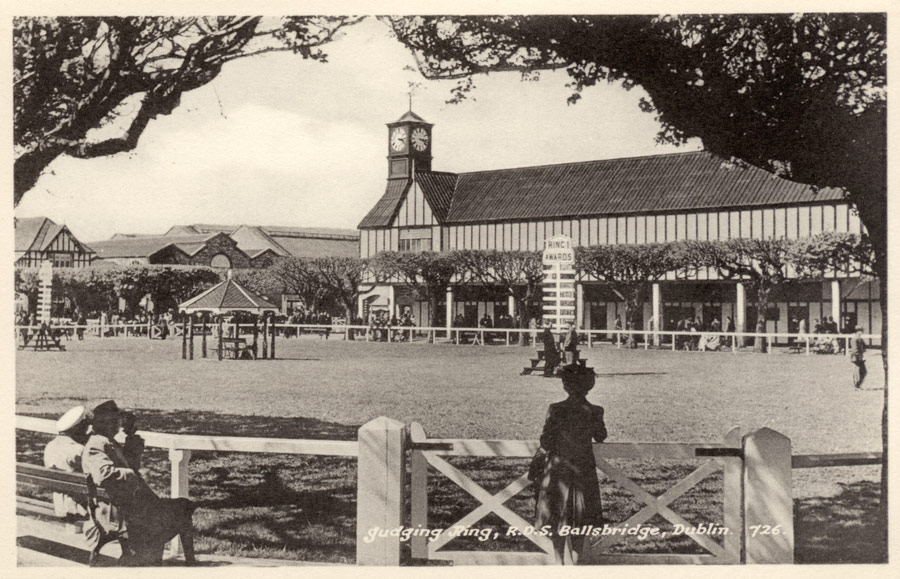
The Royal Dublin Society (RDS) had run shows or festivals of an agricultural nature from the early 1830s. These were held at the RDS grounds at Leinster House, the premises that now houses the Oireachtas or Irish parliament. Records also show that the RDS gave the same grounds to the Royal Agricultural Society of Ireland to run horse events in 1864 and 1866 before it decided to embark on its own equestrian venture on the 28th July 1868. The latter was the inaugural Dublin Horse Show, the brainchild of Lord Howth, a hunting enthusiast who had a knowledgeable eye for a good hunting horse. On that occasion, there were four days of competition where horses would negotiate the High Leap, the Wide Leap and the Stone Wall. RDS records describe the jumps as being of timber and gorse hedging, a stone wall and a 16-foot water jump with furze in front of it. Horses were judged on style and technique and scored by judges – a system which drew much controversy over the years.
The RDS again ran the show in 1869 and 1870 before the Royal Agricultural Society, which had been running its own shows through Ireland, took it up again in 1871 this time at a new location in Ballsbridge. This would later become the new home of the Royal Dublin Society and the current location for the Dublin Horse Show. Sir Arthur Guinness, grandson of the brewery owner, helped to negotiate the initial move to Ballsbridge and in 1889 the owner of the land, Lord Pembroke, signed a lease to the Society for an annual rent of £180 for 500 years! By 1890 attendance at Ballsbridge approached 60,000 and competitors were now jumping courses of fences.
At that time, shows were developing throughout Europe and further afield. Madison Square Garden in New York held its first show in 1883 while Holland and Italy also turned to the sport in the latter part of the century. A new body for governing the sport Internationally, the Federation Equestre Internationale (FEI) was constituted in 1921 and ten years later the Irish system of judging errors in jumping was moulded into those of the international body. The first Nations Cup, exclusively for the military was staged in London’s Olympia in 1909. and the first international competition in Dublin took place in 1926. A young Aga Khan, who was educated by two Irish tutors, heard about the proposed new Nations Cup in Dublin and offered a trophy for the winning team in appreciation of all the pleasures he had experienced at previous horse shows and in gratitude of his Irish tutor, Mr. Kenny. Today the winning team still receives the Aga Khan Trophy, the sixth version of the trophy, as it has been won outright 5 times, by the Swiss in 1930, Ireland in 1937 and 1979, and Britain in 1953 and 1975.

Variety
The Ballsbridge venue is just a twenty-minute walk from Dublin’s city centre and maintains that same air of excitement for what is now a five-day spectacle. As well as the International classes there is a host of national jumping classes. Add to this some showing classes and even pony games and the equine entertainment value for the public is attractive. Horses must pre-qualify for the national competitions in Dublin and places are limited. Riders like Billy Twomey, Shane Breen, Dermott Lennon, Jessica Kurten, Bertram Allen, Marion Hughes, and Darragh Kenny are just some of Ireland’s current international riders who cut their teeth in the pony competitions there and, no doubt, the high standard in those classes helped mould their international careers.

Then there are the breeders. They come from every corner of Ireland, some to watch, while others are lucky enough to have qualified a horse for one of the showing or loose performance classes. The outcome can be lucrative if the horse performs well as buyers of many nationalities are watching for the next superstar. In the Young Horse jumping classes the best horses are tested over two qualifiers before the champion is revealed. International riders from some of the visiting Nations Cup teams help with the selection of the 4-year-old winner, a horse that is likely to travel home to a new stable or even a new country after the event is over. There is satisfaction among the public when the quality is good, and in recent years, it has been, for it is the dream of every Irish horseman or woman to breed or produce the exceptional sport horse.

The Royal Dublin Society has played its part too in the improvement of the breeding stock in Ireland. The introduction of new classes with an emphasis on the performance potential of horses provides encouragement for breeders. Horses like Arraghbeg Clover (winner of the World Breeding Championships for 5-year-old horses in 2013) and MHS Going Global (who made his debut in the Global Champions Tour recently with rider Greg Broderick), are products of the system and are the new standard bearers for Irish breeding. The Governing body for non-thoroughbred horse sports in Ireland, Horse Sport Ireland, has also been very proactive since its foundation in 2008 and the positive effects for many aspects of the Irish horse industry are noticeable. An Inward Buyer System reimburses buyers with their air fare while substantial prize money for young horse leagues that run throughout the season have encouraged some owners to produce horses rather than sell them as foals.
MORE THAN ATHLETES
But Dublin is not just about the elite athlete. The diversity of activities is its recipe for success. Hundreds of trade stands in the indoor hall are constantly thronged with shoppers looking for that special bargain. Between competitions Haute École rider Clémence Faivre gave displays of awesome horsemanship on a brideless stallion, leaving even the most accomplished riders feeling inadequate. Outside of the main jumping arena, two showing arenas were continually hosting showing classes for a wide diversity of horses. Irish draught horses, broodmares, foals and even a Racehorse to Riding Horse competition. This year that was won for the second time by For Paddy The Plasterer, a winner of two Grade 1 races and many more, but now retired and still perfectly healthy. Former trainer Tom Cooper was on hand to congratulate rider Joanne Quirke. Joanne rides the former racing star every morning, sometimes in the arena, sometimes on the gallop, sometimes on the roads or down by the river. In terms of soundness they tell me his is perfect after his career – “he has legs like Naomi Campbell” they joke.
The Irish horse and pony have always been synonymous with soundness and athleticism. That heritage comes from the powerful draught horses used on the farms until the advent of the tractor, and the native Connemara pony that runs wild in parts of the west of the country to this day. This soundness is of value in the hunting fields where not only the horses bravery is tested but the riders too. Bravery leads to confidence and nowhere is this more evident than in the pony jumping classes in Dublin. In particular, the 128cm pony jumping classes. The finalists of this championship are afforded the privilege of competing in the main arena just after the Nations Cup is completed. Here, rider after rider, some as young as ten years of age, test their nerve as they gallop to the cheers of the spectators in the hope that they might be crowned the Dublin champion for 2015.

Rhys Williams from Ennis in County Clare is 11 years-old and qualified for the final in the main arena this year by winning one of the qualifying competitions. While luck did not go his way in the final he admits to having a fabulous experience – a bit like a roller coaster, some highs and some lows. He rides a fourteen-year-old palomino mare, Lolita, and an eleven-year-old black gelding, Giggles. Rhys celebrates his birthday every year at the show with three other competitors and his mother Paula treats them to a special cake for the occasion. During the year, Rhys gets up early each morning to exercise his ponies before he has his breakfast and then goes to school. After school he rides other ponies, does his school homework and goes to bed. He describes himself as a showjumper who goes to school. He admits to loving his time with the ponies, but not the schoolwork! The confident youngster aspires to compete on the Global Champions Tour and to be part of the Aga Khan team in the future. His motor Paula admits that being a pony mum is exhausting. It’s emotional, it’s hard work, it’s nerve wrecking, its mentally draining: “The kids put in a lot of time and hard work and you want to make sure they are happy. We had some highs and some lows in Dublin, but I am glad we had both. It keeps them level and that’s important. It’s a tough thing for a ten-year-old kid to learn. They must learn to take the lows with the highs.”

And finally, there’s Ladies Day. Over 500 elegant looking ladies added a touch of colour and class to the occasion by presenting themselves in the latest fashion style. In front of some of Ireland’s fashion gurus winners are chosen in a number of categories with the Best Dressed Lady being €10,000 richer for her troubles. This year the overall winner Laura Jayne Halton impressed the judges with her stunning black dress and accompanying black and cream cape from her own collection. Fast becoming a name in fashion in her own right, Laura Jayne’s designs have already received some national and international attention.
By the end of Horse Show week over 100,000 people will have passed through the gates of the Ballsbridge venue. They head back to their homes richer from their experience here. Some are already planning for next year’s event which will bring its own uniqueness to a spectacle that launched the sport of showjumping in 1868.

Advertisement
Great story..keep up the good work for those of us who cannot be there in person
My dear friend Kathy Kusner of the US Equestrian team won the Irish Trophy in back to back years in the 1960s on her great horse Untouchable, an ex Racehorse American Thoroughbred
Thanks for the comment Kris. Sorry I have been so late replying. I have been unwell lately.
Frank Mulvihill
Got it! Thanks a lot again for helnipg me out!